
Business Insurance in Singapore: Types, Mandatory Requirements & Risk Planning

Zahira Shaik
SEO Content Writer
Zahira Shaik is an SEO Content Writer and Published Author specializing in research-based content. She excels at analyzing market trends, regulations, and industry developments… Read more

Tulika Saxena
AVP, Sales & Marketing | IIM Nagpur
Tulika Saxena specializes in business finance, sales strategy, and market positioning. Leads growth and partnerships, ensuring seamless business setup experiences and client success across… Read more


Key Fact: Under Singapore law, all manual employees and non-manual employees with a monthly salary below S$2,600 must obtain Business Insurance, in addition to motor insurance for firm-owned vehicles. Lack of adherence to mandatory coverages is a punishable offense and is penalized through fines.
Table of contents
- What Is Business Insurance in Singapore?
- Why Business Insurance Matters
- Who Needs Business Insurance?
- Which Business Insurance Is Mandatory in Singapore?
- Common Types of Voluntary Business Insurance
- What Insurance Does Your Business Actually Need?
- Assessing Insurance Coverage Gaps: An Integrated Workflow
- Insurance Requirements for Platform Workers in Singapore
- How bizSAFE Supports Business Risk Management
- How Much Does Business Insurance Cost in Singapore?
- What Documents Should Businesses Maintain for Insurance?
- Common Business Insurance Mistakes to Avoid
- How Arnifi Helps With Business Insurance Planning
- Frequently Asked Questions
- References
Getting to know commercial insurance coverages in Singapore means knowing where the line lies between mandatory compliance with the law and proper risk planning and management of a business. While there are basic guides on commercial insurance that provide general information on different policy coverages, what will protect your business is aligning your operational risk exposure with an appropriate cover.
This guide highlights mandatory insurance categories, important voluntary insurance, 2025 platform worker obligations, bizSAFE, and an insurance process flow in a corporate setup.
What Is Business Insurance in Singapore?
Insurance for Businesses in Singapore is a type of risk management tool intended to protect businesses from both direct and indirect financial loss. Insurance for businesses is governed by regulations set by the Monetary Authority of Singapore (MAS). Insurance for businesses includes:
- Accidental Liabilities: Any accident causing bodily injury or property damage on business premises.
- Legal Claims: Any lawsuits arising due to mistakes or breach of duties in carrying out their business.
- Operational Disruptions: Any disruption in business activity due to unforeseeable natural or artificial conditions.
Why Business Insurance Matters
Maintaining appropriate policy coverage goes beyond simple risk management; it is a core pillar of operational strategy and corporate compliance:
- Protects Financial Capital: Prevents single catastrophic liabilities or litigation costs from draining company reserves.
- Safeguards Physical Assets: Protects machinery, inventory, IT infrastructure, and leased premises.
- Ensures Operational Continuity: Replaces lost operational income during forced business shutdowns.
- Builds Stakeholder Trust: Demonstrates commercial credibility to enterprise clients, institutional investors, and bank partners.
- Ensures Statutory Compliance: Keeps the company compliant with the Ministry of Manpower (MOM) and Singapore legal statutes.
Who Needs Business Insurance?
Virtually every registered entity operating in Singapore requires some degree of insurance coverage. Key operational profiles include:
- Employers: Entities hiring local or foreign workforces (statutory obligations apply).
- Fleet & Logistics Operators: Companies owning or managing vehicles for commercial operations or deliveries.
- Customer-Facing Operations: Retail outlets, food & beverage (F&B) venues, clinical practices, and event spaces.
- Professional Service Providers: Corporate advisors, legal practices, accounting firms, and management consultancies.
- Digital & Tech Platforms: SaaS providers, e-commerce storefronts, and firms managing sensitive user data.
- Capital-Intensive Enterprises: Logistics hubs, manufacturers, and firms holding high-value inventory or physical equipment.
Which Business Insurance Is Mandatory in Singapore?
Singapore law mandates specific insurance policies based on workforce roles, income thresholds, and vehicle usage.
1. Work Injury Compensation Insurance (WICA)
Under the Work Injury Compensation Act (WICA) administered by the Ministry of Manpower (MOM), employers must maintain work injury compensation insurance for:
- All manual workers (regardless of earnings level).
- Non-manual employees earning at or below the statutory salary threshold (S$2,600 per month).
What WICA Covers
- Medical expense reimbursement for work-related injuries or illnesses.
- Compensation for temporary incapacity (lost wages during medical leave).
- Lump-sum payouts for permanent incapacity or work-related death.
2. Motor Insurance
Under the Motor Vehicles (Third-Party Risks and Compensation) Act, any company that owns, leases, or operates motor vehicles on Singapore roads must secure third-party motor insurance.
What Motor Insurance Protects
- Third-Party Liability: Mandatory coverage for third-party bodily injury or death resulting from vehicle operations.
- Comprehensive Commercial Upgrades: Optional coverage for fleet damage, fire, theft, and operational vehicle collision repair.
Common Types of Voluntary Business Insurance
While not mandated by statute, voluntary insurance policies protect against industry-specific operational vulnerabilities.
1. Public Liability Insurance
- Scope: Shields businesses against third-party claims for accidental bodily injury or property damage caused by business operations or occurring on premises.
- Target Audience: Highly critical for brick-and-mortar stores, customer-facing outlets, trade venues, and public-space operators.
2. Professional Indemnity Insurance (PII)
- Scope: Covers legal defense expenses and settlement costs arising from alleged professional negligence, errors, omissions, or breach of professional duty.
- Target Audience: Consultants, advisors, accountants, architects, engineers, and specialized service providers.
3. Property Insurance
- Scope: Covers physical structures, office fittings, specialized equipment, and inventory against hazards such as fire, water damage, theft, and natural catastrophes.
- Target Audience: Companies managing physical spaces, warehouses, or hardware assets.
4. Business Interruption Insurance (BII)
- Scope: Replaces lost net income and covers ongoing fixed operating expenses (such as rent and payroll) when covered property damage temporarily halts operations.
- Target Audience: Capital-intensive businesses, manufacturers, and retail chains that rely on physical continuity.
5. Cyber Insurance
- Scope: Protects against expenses linked to data breaches, ransomware attacks, system downtime, network restoration, regulatory investigation defense, and third-party privacy notifications.
- Target Audience: E-commerce stores, fintech providers, SaaS platforms, and any organization processing confidential digital data.
What Insurance Does Your Business Actually Need?
To build an efficient insurance portfolio without overpaying for unnecessary coverages, evaluate the following four parameters:
| Evaluation Factor | Key Considerations | Recommended Action |
| Nature of Business | High-risk physical operational environments (e.g., construction, manufacturing) vs. low-risk advisory environments. | Match physical risk profiles with expanded public liability, property, and WICA policies. |
| Scale of Operations | Headcount total, total physical asset valuation, and revenue size. | Startups can start with core statutory policies and scale into specialized coverage as workforce and revenue grow. |
| Regulatory Obligations | Mandatory statutory rules (MOM, LTA, MAS requirements). | Maintain compulsory WICA and Motor coverage to avoid severe statutory fines and legal penalties. |
| Risk Assessment | Identifying operational vulnerabilities, data risks, and client contract requirements. | Perform an annual gap assessment to map emerging vulnerabilities directly to policy limits. |
Assessing Insurance Coverage Gaps: An Integrated Workflow
The process of insurance planning must not be done independently. Integrate your assessment of coverage into the key tools of your business planning for effective alignment with growth:
1. Leverage cost calculation tools for assessment of operational overhead costs, insurance premiums, and cash reserves available for payment of deductibles.
2. Conduct compliance and AML checks for identification of regulations and risk requirements that mandate certain policy endorsements.
3. Leverage organizational charts for assessment of manual versus non-manual staff, salary bands, and contractors on the platform for compliance with WICA laws.
4. Leverage policy schedules, renewal dates, claims history, and commercial contracts for integration into central document repositories for annual assessment of policies.
Insurance Requirements for Platform Workers in Singapore
The regulatory environment for digital platforms and gig workers is evolving rapidly under updated Singapore guidelines.
Platform Worker Protections (Effective 1 January 2025)
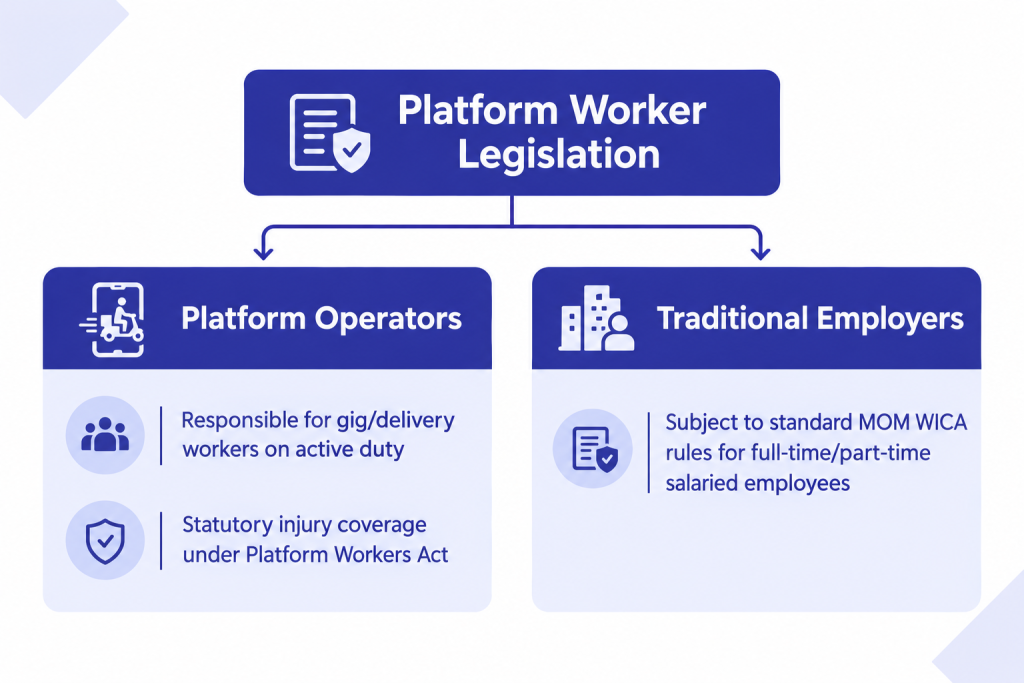
- Mandatory Coverage: Digital platforms must extend Work Injury Compensation coverage to platform workers (such as ride-hailing drivers and delivery workers) under the statutory Platform Workers Act.
- Statutory Responsibility: The legislation clarifies the legal responsibilities of Platform Operators vs. traditional Employers.
How bizSAFE Supports Business Risk Management
The bizSAFE scheme, which is implemented through the Workplace Safety and Health (WSH) Council, allows organizations to create well-structured safety standards:
- Strengthens Operational Risk Control: Helps to spot and reduce workplace risks before accidents happen.
- Enhances Tender Readiness: Numerous government agencies and corporate clients require businesses to be bizSAFE Level 3 (or above) certified before bidding on tenders.
- Influences Insurance Premiums: By demonstrating good risk management skills and fewer claims, a company will be able to get lower commercial insurance premiums.
Practical Note: bizSAFE certification should not be treated just as another piece of bureaucracy, but rather as a tool to minimize the number of accidents and cut insurance costs.
How Much Does Business Insurance Cost in Singapore?
Commercial policy pricing varies significantly based on an organization’s risk profile. Key cost drivers include:
- Industry Risk Rating: Construction and heavy logistics incur higher risk rates than IT consulting or general corporate advisory services.
- Headcount & Payroll Volume: WICA premiums scale directly with total payroll and worker risk classifications.
- Sum Insured & Coverage Limits: Higher coverage caps and lower policy deductibles increase base annual premiums.
- Claims History: A clean record with zero claims helps secure lower renewal rates.
Policy Premium Overview
| Coverage Category | Typical Coverage Scope | Estimated Annual Premium Range (SGD)* |
| Work Injury Compensation | Statutory medical expenses & lost wages | S$100 – S$500 per worker/year (varies by risk) |
| Public Liability | S$1M – S$5M third-party liability limits | S$300 – S$1,500 / year |
| Professional Indemnity | S$500k – S$2M error & omission protection | S$800 – S$3,500+ / year |
| Office Property & Contents | S$50k – S$250k asset protection limit | S$250 – S$800 / year |
| Cyber Insurance | Data breach, downtime & recovery costs | S$1,200 – S$5,000+ / year |
*Note: Figures are baseline market estimates for small-to-medium enterprises (SMEs) and vary based on risk assessments.
What Documents Should Businesses Maintain for Insurance?
To ensure rapid claims processing and smooth policy renewals, keep these organized records on hand:
- Active Policy Schedules: Detailed documents listing coverage scope, endorsement clauses, exclusions, and limits.
- Payment Receipts & Invoices: Proof of premium settlement to ensure uninterrupted coverage.
- Incident & Safety Logs: Official logs of workplace injuries, equipment failures, or third-party incidents.
- Asset Registers & Payroll Records: Updated inventories of company equipment alongside monthly MOM payroll records.
Document Review Checklist
- Track policy expiration dates 60 days before contract termination.
- Schedule annual coverage reviews to account for new operational activities or asset purchases.
- Adjust WICA payroll declarations whenever overall workforce numbers or salary levels change.
Common Business Insurance Mistakes to Avoid
- Underestimating Operational Risks: Opting for baseline policy limits that fail to cover real financial loss exposures.
- Failing to Conduct Regular Reviews: Allowing policies to auto-renew without updating coverage for new staff, bigger offices, or added service offerings.
- Ignoring Statutory Mandatory Insurance: Failing to purchase compulsory WICA or Motor policies, leaving the firm open to MOM fines and prosecution.
- Buying Policies Without Prior Risk Assessment: Purchasing off-the-shelf coverage packages that leave core operational vulnerabilities unaddressed.
How Arnifi Helps With Business Insurance Planning
Arnifi helps companies integrate risk management and insurance planning directly into their corporate governance workflow:
- Risk Profile Evaluation: Identifying operational exposures to clarify mandatory statutory obligations vs. voluntary coverage options.
- Compliance Management: Keeping statutory WICA policies aligned with changing MOM salary limits and workforce rules.
- Documentation Hub: Streamlining policy renewals, corporate record-keeping, and compliance checks in one place.
- Integrated Corporate Planning: Aligning business setup, AML checks, organizational structures, and cost calculations into a single risk management strategy.
Frequently Asked Questions
What business insurance is mandatory in Singapore?
Businesses operating in Singapore are obliged to provide mandatory Work Injury Compensation Insurance (WICA) for all manual workers and non-manual workers who earn S$2,600 or less a month and Motor Insurance for all their company-owned/operated vehicles.
Is Work Injury Compensation Insurance mandatory for all employees?
No, WICA is required for all manual workers irrespective of their earnings and for non-manual workers whose monthly earnings are S$2,600 or less. Nonetheless, MOM advises all firms to insure all their employees against employer liability under common law.
What happens if a business does not maintain mandatory WICA insurance?
Lack of mandatory WICA insurance in Singapore is an offense. Employers are liable to a fine of up to S$10,000 and/or a jail term of up to 12 months for each offense.
Do Singapore businesses need public liability insurance?
Public liability insurance is not required by any statute in Singapore, but it is almost compulsory for retail, F&B, events, and customer-facing companies. Most landlords/managers of commercial buildings require this kind of insurance before leasing to you.
Do platform workers need insurance in Singapore?
Yes. According to the Platform Workers Act (effective from 1 January 2025), digital platforms will be obligated to cover platform workers providing ride-hailing or delivery services in the form of work injury compensation insurance when on active duty.
Does bizSAFE certification lower business insurance premiums?
Although bizSAFE certification cannot ensure low premiums in any way, most insurers see certified companies as low-risk clients, so they can offer competitive premiums and better policy conditions.
How often should a business review its commercial insurance policies?
A company needs to consider its insurance policies once a year or after significant company events, like a hiring spree, engaging in new types of activities, acquiring expensive assets, or concluding large contracts.
References
- Ministry of Manpower (MOM) – Work Injury Compensation Act (WICA):
https://www.mom.gov.sg/workplace-safety-and-health/work-injury-compensation - Monetary Authority of Singapore (MAS) – Insurance Regulatory Framework:
https://www.mas.gov.sg/regulation/insurance - Workplace Safety and Health (WSH) Council – bizSAFE Program:
https://www.wshc.sg/bizSAFE - Singapore Statutes Online – Motor Vehicles (Third-Party Risks & Compensation) Act:
https://sso.agc.gov.sg
Top Singapore Packages
Related Articles
Top Singapore Packages
Planning Your Next Business Move?
