
Offshore Companies vs Onshore Companies | A Comparative Guide

Anushka
Content Writer
Anushka Basu is a business content writer specialised in global business market insights. She aims to simplify complex regulatory, financial, and business concepts into… Read more


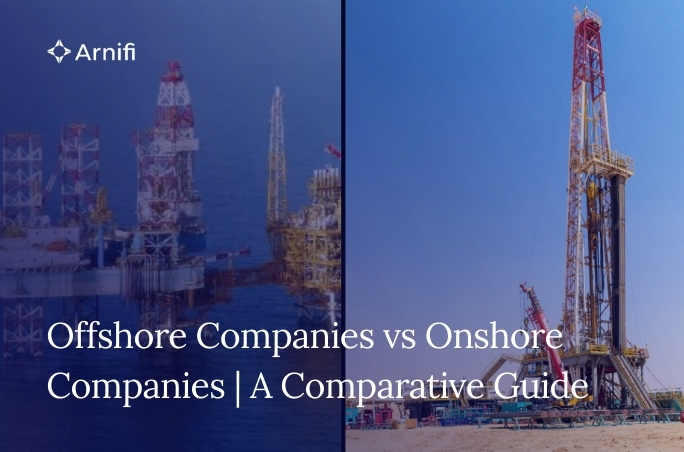
Choosing offshore vs onshore companies is not only a legal decision. It is a business decision that shapes tax exposure and banking ease while maintaining compliance and ensuring the company will grow in the future.
A lot of founders think one is always smarter than the other. It is rarely that simple. The better option usually depends on what the company will actually do and where customers are. Also, knowing how much operational substance the business needs is important.
Let’s break down offshore companies vs onshore companies in multiple domains to know which is beneficial for your business.
Table of contents
- Start With the Basic Meaning
- The Real Difference Is Business Purpose
- Offshore Companies vs Onshore Companies Side by Side Comparison
- When an Offshore Company Usually Makes Sense
- When an Onshore Company Is the Better Choice
- Tax Is Important, but Not the Full Answer
- Banking Changes the Whole Picture
- Compliance and Substance Are Now Bigger Than Before
- Which One Suits Which Founder
- How Arnifi Assists Help Offshore Companies Formation
- Conclusion
- FAQs
Start With the Basic Meaning
The simplest way to explain this is easy.
An onshore company is usually formed in the country where the business mainly operates and hires people while paying local tax. An offshore company is usually formed in another jurisdiction. This includes holding assets, owning shares, managing international structuring, supporting cross-border business, etc.
That is the basic offshore and onshore company meaning. The confusion starts when people assume offshore means better and onshore means expensive. Real life is more mixed than that.
The Real Difference Is Business Purpose
At first glance, this looks like a tax comparison. It is not only that.
The real difference between offshore and onshore companies usually comes down to business purpose. If the company needs strong local presence, local staff, local licences, and easy domestic trading, an onshore company often makes more sense.
If the company is mainly a holding vehicle or a parent company above businesses in different countries, an offshore structure may be more useful.
That is why founders get confused. They compare company types before defining the job of the company itself.
Offshore Companies vs Onshore Companies Side by Side Comparison
This comparison below clears up a lot. It shows that an offshore company vs onshore company decision is really about fit, not status.
| Factor | Offshore company | Onshore company |
| Main purpose | Holding, structuring, cross-border ownership | Trading, hiring, local operations |
| Tax position | Often lighter at company level, depending on jurisdiction | Usually taxed under local corporate rules |
| Compliance style | Can be lighter in some areas, but still formal | Usually broader and more operational |
| Banking | Can be harder if the business story is weak | Often easier if the business is local and active |
| Reputation in daily trade | Better for holding or international structures | Better for contracts, local suppliers, and direct operations |
| Substance expectations | Important if the company carries real activity | Usually built into the local business model |
When an Offshore Company Usually Makes Sense
An offshore company works best when the business has a real cross-border reason behind it. Think of a parent company holding shares in more than one country and a family investment structure with investors spread across markets.
In those cases, the offshore company is not doing the daily selling. It is sitting above the action and keeping ownership cleaner.
Good offshore use cases
- Holding shares in overseas subsidiaries
- Owning investment assets or IP
- Creating a parent company for a cross-border startup
That is where the onshore and offshore company comparison starts to feel practical. Offshore is often stronger for structure. It is not always stronger for operations.
When an Onshore Company Is the Better Choice
Onshore companies usually work better when the business is active in one country and needs to look and feel local. If you need payroll, supplier agreements, local licences, tax registration, or a strong banking relationship tied to one market, onshore is often the cleaner answer.
A simple example helps. A restaurant or regional service company usually gains very little by using an offshore structure as the main operating entity. It may even create friction.
Actually, let’s make that clearer. An offshore company can still sit above that business as a holding layer. But the operating company itself often belongs onshore.
Tax Is Important, but Not the Full Answer
A lot of founders begin and end the discussion with tax. That usually leads to weak structuring.
Yes, offshore jurisdictions may offer a lighter company-level tax environment. But if the business is effectively managed or commercially active in another country, tax exposure can still arise there. That is exactly why some founders set up an offshore company and still end up carrying onshore tax and reporting obligations.
So the better question is not “Where is tax lower?” It is “Where does the business actually live?”
That one question saves a lot of bad decisions.
Banking Changes the Whole Picture
This is the part people usually underestimate. A structure that looks neat on paper can feel frustrating if the banking story is weak. Offshore companies often face more onboarding questions because banks want to understand ownership and why the company stays in that jurisdiction. Onshore companies can have an easier time if the business is clearly local and tied to visible operations.
What founders should compare before choosing:
- Where customers and revenue will sit
- Which company will sign contracts
- How the bank will understand the structure
This is where many founders course-correct. They realise the right answer is not the most tax-efficient one on paper. It is the one that still works after account opening and day-to-day payments begin.
Compliance and Substance Are Now Bigger Than Before
Years ago, people spoke about offshore companies like they were light paperwork and little else. That picture does not hold up well now.
Offshore jurisdictions still work well for the right use cases, but compliance is more active and ownership transparency matters more. Onshore companies also carry their own weight through payroll rules, tax filings, local reporting, and industry regulation.
So, no, offshore is not the easy route in every case. Onshore is not automatically the heavy route either. It depends on what the company is actually built to do.
Which One Suits Which Founder
For most founders, the easiest way to decide is to think about the company’s job in one sentence.
If the company will own and hold, offshore may fit. If the company will hire and sell while invoicing locally, and operate visibly in one market, onshore usually fits better.
Part of you may think there should be a more dramatic answer than that. There usually is not. The strongest structures are often the simplest ones that still match the business model.
How Arnifi Assists Help Offshore Companies Formation
Arnifi can help founders compare offshore and onshore routes based on the real business model. We help assess holding needs, local operating needs, banking fit, and future expansion plans so the company structure supports actual growth. That makes the final setup easier to explain and easier to use while being much less likely to need fixing later.
Conclusion
The best answer in offshore vs onshore companies is rarely about labels. It is about function. Offshore usually works better for holding and international structuring. Onshore usually works better for active operations and local market presence. Founders make better decisions when they choose based on business reality and long-term usability.
FAQs
1. What is the main difference between offshore and onshore companies?
An offshore company is usually used for holding or cross-border structuring. An onshore company is usually used for local operations, hiring, invoicing, and visible business activity in one market.
2. Is an offshore company always better for tax?
No. A lighter offshore tax position does not remove tax exposure in the countries where the business is actually managed, staffed, or commercially active. That wider picture matters more.
3. Is an onshore company better for banking?
Often yes, especially if the business is local and easy to explain. Offshore companies can still bank successfully, but they usually need a clearer ownership and business story.
4. Can a business use both offshore and onshore companies together?
Yes. That is quite common. An offshore company may sit as a parent or holding layer, while one or more onshore companies handle the actual trading and operations.
Top UAE Packages


Related Articles
BVI vs Cayman Company Formation (2026) | Entity Ty...
Key Fact Both jurisdictions provide English common law frameworks for international business. BVI offers cost-efficient corporate management for private asset...


Top UAE Packages
Get in Touch