
BVI Company Dissolution vs Liquidation vs Cease to Carry Business | Key Differences

Anushka
Content Writer
Anushka Basu is a business content writer specialised in global business market insights. She aims to simplify complex regulatory, financial, and business concepts into… Read more

Tulika Saxena
AVP, Sales & Marketing | IIM Nagpur
Tulika Saxena specializes in business finance, sales strategy, and market positioning. Leads growth and partnerships, ensuring seamless business setup experiences and client success across… Read more


Key Fact: In the BVI, ceasing to carry on business and liquidation are different processes or circumstances that can relate to a company’s eventual closure. Dissolution is the legal end of the company’s existence.
Table of contents
- What is the difference between BVI dissolution, liquidation and ceasing to carry on business?
- When can a BVI company cease to carry on business?
- What happens when a BVI company ceases to carry on business?
- What is BVI company liquidation?
- What is voluntary liquidation in the BVI?
- What happens if a BVI company is insolvent?
- BVI company ceasing to carry on business vs liquidation | What is the difference?
- Is dissolution the same as ceasing to carry on business in the BVI?
- What happens to a BVI company’s assets and liabilities after dissolution?
- Can a dissolved BVI company be restored?
- What happens if a BVI company is in penalty?
- How do you close a BVI company properly?
- What factors should you consider before leaving a BVI company inactive or pursuing liquidation?
- What are the common mistakes when closing a BVI company?
- How can Arnifi help with BVI company closure?
- FAQs
- Conclusion
What is the difference between BVI dissolution, liquidation and ceasing to carry on business?
Closing a BVI company involves more than stopping business activity. Dissolution describes the legal end of the company’s existence, while ceasing to carry on business and liquidation relate to different aspects of bringing a company’s activities to an end.
| Term | What it means | Typical context |
| Dissolution | Legal ending of the company’s existence | Outcome |
| Ceasing to carry on business | The company stops conducting business activities | Business inactivity or cessation |
| Liquidation | Formal winding-up of the company’s affairs | Assets, liabilities and creditor matters |
The distinction matters because a dormant company with no unresolved affairs may have a different closure route from a company holding assets, owing debts or involved in active contracts.
When can a BVI company cease to carry on business?
A BVI company may cease to carry on business when it stops conducting its commercial activities. However, ceasing business is not itself a formal dissolution or liquidation procedure.
The current framework should therefore be considered separately from the company’s actual cessation of business activities.
- A company may stop conducting business activities.
- The company may continue to have assets or liabilities after business activities stop.
- The company may continue to have corporate and regulatory obligations.
- Bank accounts, contracts and intellectual property may remain in place.
- The company’s legal existence may continue until the applicable closure process is completed.
Businesses should therefore avoid assuming that ceasing to carry on business automatically results in dissolution.
What happens when a BVI company ceases to carry on business?
Ceasing to carry on business should not be treated as an informal way to cancel a company. A company can stop operating while continuing to exist as a legal entity and while retaining assets, liabilities and other obligations.
Before leaving a company to remain inactive, owners should review:
- Company assets
- Outstanding liabilities
- Bank accounts
- Contracts
- Intellectual property
- Corporate records
- Beneficial ownership information
- Potential creditor claims
A company that has unresolved affairs may require a more structured closure process rather than simply ceasing to carry on business.
What is BVI company liquidation?
Liquidation is a formal process used to wind up a company’s affairs. A liquidator is appointed to deal with the company’s assets, liabilities and other outstanding matters before the company reaches dissolution.
The process can involve:
| Stage | What happens |
| Appointment | Liquidator is appointed |
| Asset review | Company assets are identified and dealt with |
| Liability review | Debts and obligations are addressed |
| Creditor matters | Applicable creditor claims are handled |
| Distribution | Remaining assets are distributed according to the applicable framework |
| Completion | Required completion documents are filed |
| Dissolution | The required liquidation completion filing is made and the applicable statutory dissolution process is completed. |
For a voluntary liquidation under the BVI Business Companies Act, the voluntary liquidator files the required completion statement. The applicable statutory process then leads to dissolution.
What is voluntary liquidation in the BVI?
Voluntary liquidation is generally relevant to a solvent BVI company that needs an orderly and documented closure. It involves a formal decision to enter liquidation and the appointment of a voluntary liquidator.
The liquidator’s responsibilities can include:
- Reviewing the company’s affairs
- Realising or dealing with assets
- Addressing liabilities
- Dealing with creditor and member interests
- Completing required filings
- Preparing the completion statement
The BVI FSC distinguishes solvent liquidation under the Business Companies Act from insolvent liquidation under the Insolvency Act, 2003.
What happens if a BVI company is insolvent?
Solvency should be established before selecting voluntary liquidation under the Business Companies Act. An insolvent company cannot simply use a solvent liquidation process as a substitute for addressing creditor claims.
| Company position | Relevant consideration |
| Solvent | Voluntary liquidation under the Business Companies Act may be available |
| Insolvent | Applicable insolvency framework should be considered |
| Unresolved creditor claims | Requires careful assessment before closure |
| Company in default | Status and outstanding obligations should be reviewed |
The BVI FSC states that companies may be liquidated under the Business Companies Act only where they are solvent, while insolvency is dealt with under the applicable insolvency framework.
BVI company ceasing to carry on business vs liquidation | What is the difference?
Ceasing to carry on business and liquidation are not the same process. A company can stop conducting business without formally winding up its affairs.
| Factor | Ceasing to carry on business | Voluntary liquidation |
| Nature | Cessation of business activities | Formal winding-up |
| Typical use | Company stops conducting business | Solvent company requiring structured closure |
| Liquidator | Not required simply because business has ceased | Liquidator appointed |
| Assets | May remain with the company | Addressed during liquidation |
| Liabilities | Continue unless properly resolved | Specifically dealt with |
| Completion | Business activities cease, but legal existence may continue | Liquidation completion followed by applicable dissolution process |
| Documentation | Depends on circumstances | Formal liquidation documents and filings |
| Restoration | Not applicable merely because business has ceased | Separate restoration considerations may apply |
This is the key distinction for businesses considering a BVI company ceasing to carry on business vs liquidation: liquidation is a formal winding-up process, while ceasing to carry on business simply means that the company’s commercial activities have stopped.
Is dissolution the same as ceasing to carry on business in the BVI?
No. Dissolution describes the company’s legal end, while ceasing to carry on business describes the cessation of its commercial activities.
The process can broadly be understood as:
Business activities cease → Company reviews assets, liabilities and obligations → Applicable closure process → Dissolution where applicable
For voluntary liquidation, the sequence is different:
Voluntary liquidation → Completion statement/required completion filing → Applicable strike-off and dissolution process
The BVI Business Companies Act provides the statutory framework for dissolution following completion of a voluntary liquidation.
What happens to a BVI company’s assets and liabilities after dissolution?
Companies should address assets and liabilities before dissolution wherever possible. Dissolution should not be treated as a substitute for properly winding up the company’s affairs.
Before closure, businesses should review:
- Cash and bank accounts
- Shares and investments
- Intellectual property
- Property interests
- Outstanding invoices
- Loans and other debts
- Contracts
- Tax or regulatory obligations
- Creditor claims
This is particularly important for companies holding meaningful assets or forming part of a wider investment or holding structure.
Can a dissolved BVI company be restored?
Restoration may be available in qualifying circumstances, but it is not automatic. The applicable process depends on factors such as how and when the company was dissolved.
Restoration can involve:
- Application to the Registrar or Court, depending on circumstances
- Appointment of a licensed registered agent
- Updating corporate information
- Bringing required beneficial ownership and corporate-register filings up to date, where applicable
- Payment of applicable fees and penalties
- Bringing outstanding requirements up to date
The 2022 amendments introduced significant changes to the restoration framework, with subsequent amendments further refining restoration requirements, so older guidance should be checked carefully before relying on a historical restoration procedure or period.
What happens if a BVI company is in penalty?
A company with outstanding filings, fees or regulatory requirements can fall into poor standing and may become subject to administrative action.
Before deciding to leave an inactive company in penalty, owners should assess:
| Area | What to check |
| Fees | Outstanding government or registered-agent charges |
| Filings | Unfiled corporate requirements |
| Ownership | Beneficial ownership information |
| Assets | Whether the company still owns property or investments |
| Liabilities | Outstanding debts or obligations |
| Future use | Whether restoration may be required later |
Doing nothing is different from deliberately completing a controlled closure. Outstanding obligations can also make a future restoration more complicated.
How do you close a BVI company properly?
The appropriate process depends on the company’s circumstances. A practical approach is:
- Review the company’s current status
- Confirm solvency
- Identify assets and liabilities
- Review contracts and bank accounts
- Check corporate and beneficial ownership records
- Determine whether the company should remain inactive or whether a formal closure process such as liquidation should be pursued
- Complete the applicable documentation
- Address outstanding obligations
- Complete the relevant closure and dissolution process
- Retain important corporate and liquidation records
The objective is to choose the closure route based on the company’s actual position rather than treating every inactive company in the same way.
What factors should you consider before leaving a BVI company inactive or pursuing liquidation?
The decision should be based on the company’s financial, operational and regulatory position. Consider:
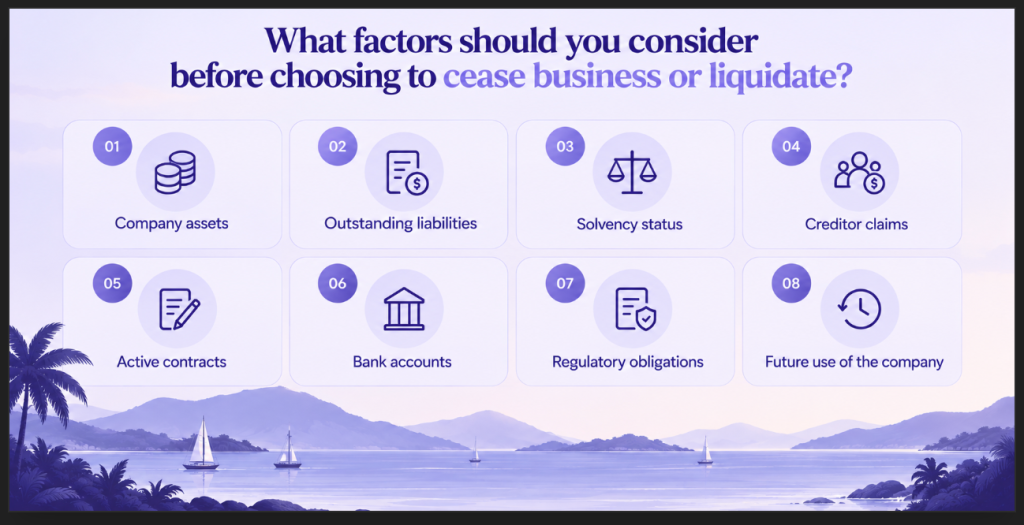
A dormant company with no meaningful unresolved affairs may have a different closure route from a company holding assets or owing money.
What are the common mistakes when closing a BVI company?
Several outdated or incorrect assumptions can create problems:
- Assuming that stopping business automatically closes the company
- Treating ceasing to carry on business and liquidation as identical
- Confusing dissolution with the closure process
- Ignoring company assets after business activities cease
- Overlooking creditor obligations
- Failing to update corporate records
- Assuming restoration is automatic
- Assuming that ceasing to carry on business automatically dissolves the company
The distinction between cessation of business, liquidation and dissolution is particularly important because stopping commercial activity does not by itself bring the company’s legal existence to an end.
How can Arnifi help with BVI company closure?
Arnifi can help businesses review their BVI company’s status and coordinate the practical steps involved in closing the entity.
Support can include:
- Reviewing the company’s closure requirements
- Helping assess whether cessation of business or liquidation should be explored
- Coordinating corporate documentation
- Supporting communication with the registered agent
- Assisting with practical closure requirements
- Coordinating with legal, accounting or insolvency professionals where specialist advice is required
The appropriate route should always be assessed against the company’s actual assets, liabilities and solvency position.
FAQs
What is the difference between BVI company dissolution and liquidation?
Liquidation is a formal winding-up process, while dissolution is the legal end of the company’s existence.
Is ceasing to carry on business the same as dissolution?
No. Ceasing to carry on business means the company has stopped its commercial activities, while dissolution is the legal end of the company’s existence.
What is the difference between BVI company ceasing to carry on business vs liquidation?
Ceasing to carry on business means commercial activities have stopped, while liquidation formally addresses the company’s affairs.
What happens when a BVI company ceases to carry on business?
The company may stop operating while continuing to exist as a legal entity and retain assets, liabilities and other obligations.
Can a BVI company be dissolved without liquidation?
Yes. The applicable BVI statutory framework provides routes to dissolution that do not necessarily require a voluntary liquidation.
Can a dissolved BVI company be restored?
Potentially, depending on the circumstances, timing and applicable restoration procedure. Restoration is not automatic.
What happens if a BVI company is in penalty?
Outstanding obligations can affect its standing and may expose the company to administrative action.
Can an insolvent BVI company use voluntary liquidation?
Solvent and insolvent liquidations operate under different frameworks. An insolvent company should consider the applicable insolvency process.
What is the BVI Business Companies Act 2004?
It is the principal legislation governing BVI companies, including incorporation, operation, liquidation and dissolution.
What is the role of the BVI Gazette in BVI company closure?
The Gazette is used to publish relevant company-status notices and other statutory notices connected with BVI companies.
Conclusion
BVI dissolution, liquidation and ceasing to carry on business describe different aspects of ending or stopping a company’s activities. Ceasing to carry on business means commercial operations have stopped, liquidation is a formal winding-up process, and dissolution is the legal end state. Solvent companies may consider voluntary liquidation under the BVI Business Companies Act, while insolvency requires the applicable insolvency framework. The appropriate route depends on the company’s assets, liabilities, solvency, records and wider structure.
Official References
Top UAE Packages
Related Articles


BVI vs Cayman Company Formation (2026) | Entity Ty...
Key Fact Both jurisdictions provide English common law frameworks for international business. BVI offers cost-efficient corporate management for private asset...
Top UAE Packages
Get in Touch
