
DMCC Gold & Precious Stones Trading Licence 2026 | Requirements, Cost & Setup Guide

Ishika Bhandari
Content Writer
Ishika Bhandari is a content writer with experience in creating SEO-focused content across diverse industries, including business, lifestyle, and jewellery. She specializes in turning… Read more

Tulika Saxena
AVP, Sales & Marketing | IIM Nagpur
Tulika Saxena specializes in business finance, sales strategy, and market positioning. Leads growth and partnerships, ensuring seamless business setup experiences and client success across… Read more


Key Facts: A DMCC Gold & Precious Stones Trading Licence allows eligible businesses to conduct approved trading activities involving gold, precious metals and precious stones from DMCC. The setup can support international and wholesale trading, with the exact scope depending on the selected activity. DMCC offers dedicated business infrastructure and commodity services, while federal authorities regulate the UAE’s precious-metals sector.
Table of contents
- Introduction
- What Is a DMCC Gold & Precious Stones Trading Licence?
- What Can You Trade Under a DMCC Gold & Precious Stones Licence?
- Who Should Consider a DMCC Gold Trading Licence?
- What Are the Requirements for a DMCC Gold Trading Licence?
- Is 100% Foreign Ownership Allowed in DMCC?
- Do You Need an Office for Gold Trading in DMCC?
- What Documents Are Required?
- How to Get a DMCC Gold & Precious Stones Trading Licence?
- How Much Does a DMCC Gold Trading Licence Cost?
- What Compliance Requirements Apply to Gold Traders?
- What Is the Role of Responsible Sourcing?
- Can a DMCC Gold Trading Company Import and Export?
- Can You Sell Gold Directly to UAE Customers?
- What Are the Tax Considerations?
- What Are the Benefits of Setting Up Gold Trading in DMCC?
- Who Should Choose DMCC for Gold Trading?
- DMCC vs Mainland Gold Trading Company
- What Common Mistakes Should Gold Traders Avoid?
- DMCC Gold Trading Licence Checklist
- How Can Arnifi Help With DMCC Gold Trading Setup?
- Conclusion
- FAQs
Introduction
Dubai is a major centre for international gold, precious-metals and gemstone trading. The Dubai Multi Commodities Centre (DMCC) has built a specialised ecosystem around commodities, offering licensing, office solutions and services designed for businesses operating in this sector. One important distinction is that DMCC provides the business infrastructure but does not regulate the UAE gold industry. Regulation of precious-metals businesses, including applicable AML/CFT requirements, is handled at the federal level by the Ministry of Economy and Tourism.
What Is a DMCC Gold & Precious Stones Trading Licence?
The licence is a DMCC business licence for approved trading activities involving commodities such as gold, precious metals and precious stones.
Depending on the activity selected, a business may undertake:
- Gold trading
- Precious-metals trading
- Precious-stones trading
- Import and export
- Wholesale and distribution
Trading and manufacturing are different activities, so a business involved in refining, manufacturing or jewellery production should confirm whether additional activities or approvals are required.
The exact activity selected at incorporation matters because the licence does not automatically cover every type of commodity or retail operation.
What Can You Trade Under a DMCC Gold & Precious Stones Licence?
| Product | Typical Business Activity |
| Gold | Trading, import and export |
| Silver | Precious-metals trading |
| Platinum | Precious-metals trading |
| Diamonds | Precious-stones trading |
| Gemstones | Precious-stones trading |
| Gold jewellery | Subject to applicable activity and approvals |
| Bullion | Gold and precious-metals trading |
The permitted scope depends on the exact DMCC activity and any additional regulatory requirements.
Who Should Consider a DMCC Gold Trading Licence?
The structure can suit:
- Gold wholesalers and bullion traders
- Precious-metal importers and exporters
- Diamond and gemstone traders
- International commodity traders
- Jewellery raw-material suppliers
- Businesses sourcing gold and precious stones internationally
It is particularly relevant for businesses using Dubai as a base for international or wholesale commodity transactions.
What Are the Requirements for a DMCC Gold Trading Licence?
Typical requirements include:
- Selecting the appropriate business activity
- Shareholder and director information
- Approved trade name
- Business plan where required
- KYC and due diligence information
- UBO information
- Source-of-funds documentation where requested
- Registered office or suitable facility
- Corporate documents for corporate shareholders
- Additional approvals where applicable
DMCC may request further information during its due-diligence process.
Is 100% Foreign Ownership Allowed in DMCC?
Eligible DMCC structures can be fully foreign-owned, so an overseas founder does not generally need a mandatory local shareholder simply because the company is being established in DMCC. Individual and corporate shareholders can be used, subject to DMCC requirements. However, foreign ownership does not remove KYC, UBO, AML or other regulatory obligations.
Do You Need an Office for Gold Trading in DMCC?
The office requirement depends on the company structure and business model. Depending on eligibility, businesses may consider flexi-desk arrangements, serviced offices or physical offices. A business handling physical inventory may separately need appropriate storage or warehouse arrangements. Not every gold trader automatically requires a large warehouse. DMCC also provides specialised commodity infrastructure, including the DMCC Vault, Tradeflow and access to the Dubai Gold and Commodities Exchange.
What Documents Are Required?
| Document | Purpose |
| Passport copies | Shareholder and director identification |
| Passport photo | Application |
| Proof of address | KYC |
| Business plan | Business and activity assessment where required |
| Corporate documents | Corporate shareholders |
| UBO information | Ownership verification |
| Bank/reference documents | Due diligence where requested |
| Source-of-funds documents | Financial compliance |
DMCC can request additional documents depending on the shareholders, structure and nature of the business.
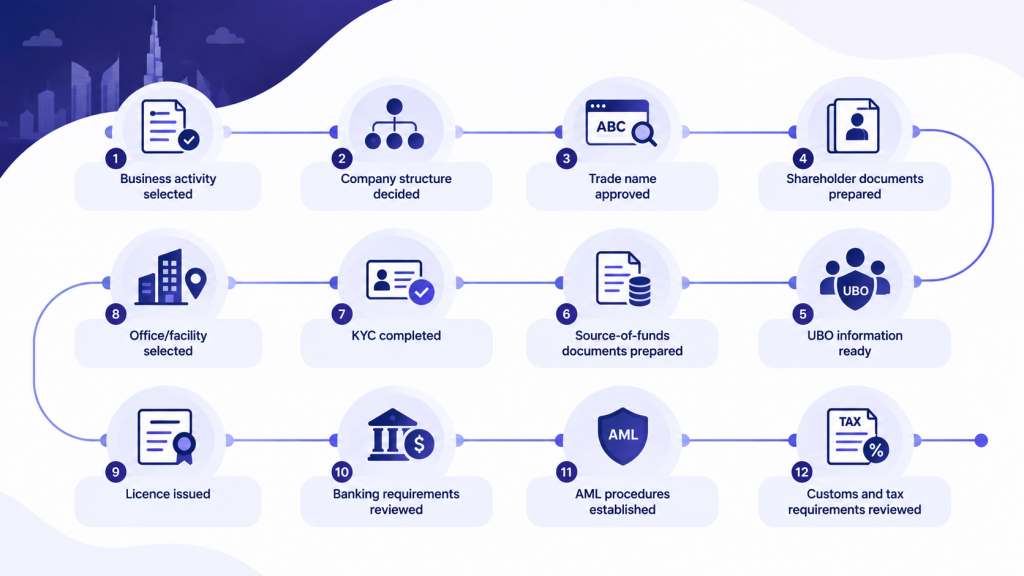
How to Get a DMCC Gold & Precious Stones Trading Licence?
Step 1: Select the Business Activity
Choose the specific gold, precious-metals or precious-stones activity that matches the planned business.
Step 2: Choose the Company Structure
Determine the shareholders and appropriate legal structure.
Step 3: Reserve the Company Name
Submit the proposed company name for approval.
Step 4: Submit KYC and Corporate Documents
Provide the required shareholder, director, UBO and corporate documents.
Step 5: Complete Due Diligence
Respond to KYC, compliance and source-of-funds requests where applicable.
Step 6: Select Office Space
Choose an appropriate office or facility based on the company’s requirements.
Step 7: Pay the Applicable Fees
Complete the required DMCC and related government payments.
Step 8: Receive the Licence
Once the required approvals and documentation are completed, the licence can be issued.
Step 9: Complete Post-Licensing Setup
The company can then proceed with establishment-card, visa, banking, tax and other operational requirements as applicable.
How Much Does a DMCC Gold Trading Licence Cost?
There is no single fixed DMCC gold licence cost for every business. The final investment depends on the activity, company structure and facilities selected.
| Cost Component | What Affects It |
| DMCC licence fees | Activity and licence structure |
| Registration/incorporation | Company structure |
| Office | Flexi desk, serviced or physical office |
| Establishment card | Immigration setup |
| Visas | Number of employees/investors |
| Compliance | Business and regulatory requirements |
| Banking | Bank-specific requirements |
| Warehouse/storage | Inventory and operating model |
A quote should therefore be based on the actual business model rather than a generic advertised licence price.
What Compliance Requirements Apply to Gold Traders?
Gold and precious-stones businesses are treated as part of the UAE’s DNFBP framework and are subject to applicable AML/CFT requirements. The Ministry of Economy supervises dealers in precious metals and stones in mainland UAE and commercial free zones.
Businesses may need appropriate procedures covering:
- KYC and customer due diligence
- Beneficial ownership
- Source-of-funds checks
- Transaction records
- Risk assessment
- Suspicious transaction reporting where applicable
- Sanctions screening
- Record keeping
Failure to treat compliance as part of the operating model can create significant regulatory risk.
What Is the Role of Responsible Sourcing?
Responsible sourcing is particularly important for businesses dealing in gold. UAE requirements address risks associated with sourcing gold from conflict-affected and high-risk areas. The Ministry’s framework follows a five-step approach covering management systems, supply-chain risk assessment, risk mitigation, independent review and periodic reporting for entities within its scope. Businesses should therefore maintain supplier records, origin information and supporting transaction documentation appropriate to their activities.
Can a DMCC Gold Trading Company Import and Export?
Yes, approved trading businesses can structure international commodity transactions through Dubai, subject to the applicable activity and customs requirements.
Depending on the transaction, businesses may need:
- Commercial invoices
- Packing lists
- Shipping documents
- Customs declarations
- Import/export documentation
- Product-specific approvals
A DMCC licence does not remove customs or product-specific requirements.
Can You Sell Gold Directly to UAE Customers?
International and free-zone trading is different from direct mainland operations. A DMCC company intending to sell directly to mainland customers, operate a retail outlet or conduct activities outside the free zone may require an appropriate mainland licence, permit or other permitted structure. Retail jewellery activities should also be checked separately because the relevant licensing and approval requirements can differ from wholesale commodity trading.
What Are the Tax Considerations?
Gold trading can be subject to UAE Corporate Tax and VAT depending on the company’s activities and transactions. VAT treatment requires particular attention. UAE rules provide specific treatment for investment precious metals and a reverse-charge mechanism for qualifying transactions involving precious metals between VAT-registered businesses. The treatment depends on the nature of the product and transaction, so gold trading should not simply be described as “tax-free.” Customs duties may also apply depending on the goods, origin and movement of products.
What Are the Benefits of Setting Up Gold Trading in DMCC?
Key advantages include:
- 100% foreign ownership for eligible structures
- Commodity-focused business infrastructure
- International trading environment
- Dubai’s logistics network
- Access to commodity traders and service providers
- DMCC Tradeflow
- DMCC Vault
- Access to the Dubai Gold and Commodities Exchange
DMCC describes Tradeflow as a platform for registering commodities stored in UAE facilities and highlights its wider gold ecosystem for international commodity businesses.
Who Should Choose DMCC for Gold Trading?
DMCC can be a strong fit for international gold traders, bullion dealers, precious-stone wholesalers, import/export companies and commodity groups looking for a Dubai base. It may be less suitable if the primary objective is unrestricted retail activity across mainland Dubai, where a mainland structure or additional approvals may be more appropriate.
DMCC vs Mainland Gold Trading Company
| Factor | DMCC | Dubai Mainland |
| Jurisdiction | Free zone | Mainland |
| Foreign ownership | Available for eligible structures | 100% available for many activities |
| International trading | Strong fit | Available |
| Mainland sales | Subject to applicable rules | Direct, subject to licence |
| Commodity ecosystem | Specialised | Depends on setup |
| Retail operations | Activity/approval dependent | Suitable with relevant licence |
What Common Mistakes Should Gold Traders Avoid?
Common mistakes include selecting the wrong activity, assuming the licence automatically covers retail, overlooking AML obligations, failing to document source of funds, weak supplier due diligence and assuming DMCC itself regulates the gold industry. Businesses should also avoid treating Corporate Tax and VAT as irrelevant or assuming that a DMCC licence automatically permits unrestricted mainland sales.
DMCC Gold Trading Licence Checklist
How Can Arnifi Help With DMCC Gold Trading Setup?
Arnifi can assist with activity selection, DMCC incorporation, documentation and KYC coordination, office arrangements, licence applications, visas, establishment-card requirements, banking assistance and ongoing accounting and compliance coordination.
Conclusion
A DMCC Gold & Precious Stones Trading Licence can provide a strong base for businesses involved in gold, precious metals and gemstones, particularly those targeting international and wholesale markets. The important part is choosing the correct activity and understanding the requirements beyond the licence itself. AML controls, responsible sourcing, customs, office arrangements and tax treatment should all be considered before operations begin.
FAQs
What is a DMCC Gold & Precious Stones Trading Licence?
It is a DMCC licence for approved trading activities involving gold, precious metals and precious stones.
How much does a DMCC gold trading licence cost?
There is no single fixed cost. The total depends on the activity, company structure, office, visas and other requirements.
Can foreigners own 100% of a DMCC gold company?
Eligible DMCC structures can be fully foreign-owned, subject to applicable requirements.
What documents are required?
Typical documents include passports, proof of address, UBO information, corporate documents and other KYC materials.
Can I trade gold internationally from DMCC?
Yes, subject to the selected activity, customs procedures and other applicable requirements.
Can a DMCC company sell gold in mainland Dubai?
Mainland sales may require an appropriate licence, permit or permitted operating structure.
Is an office required?
The appropriate office solution depends on the company structure and business activity.
Are gold traders subject to AML requirements?
Yes. Dealers in precious metals and stones fall within the UAE DNFBP framework and applicable AML/CFT requirements.
Do jewellery businesses need additional approvals?
Potentially. Jewellery trading or manufacturing should be assessed according to the exact activity and operating model.
Is gold trading subject to Corporate Tax?
Potentially, depending on the company’s taxable income and applicable UAE Corporate Tax rules.
How is VAT applied to gold trading?
VAT treatment depends on the product and transaction, including specific rules for investment precious metals and qualifying B2B transactions.
How long does a DMCC gold licence take?
The timeline depends on document readiness, KYC, due diligence, activity and approvals.
Can I open a corporate bank account after licensing?
A licensed company can apply for a corporate bank account, but approval remains subject to the bank’s KYC and risk assessment.
Is DMCC suitable for international gold traders?
Yes. Its commodity-focused ecosystem makes it particularly relevant to international and wholesale trading businesses.
Does DMCC regulate the UAE gold industry?
No. DMCC provides licensing and business infrastructure, while federal authorities regulate the sector.
References:
Top UAE Packages


Related Articles

Top UAE Packages
Get in Touch