
Can a Free Zone Company Work in the Mainland UAE? | Explained

Anushka
Content Writer
Anushka Basu is a business content writer specialised in global business market insights. She aims to simplify complex regulatory, financial, and business concepts into… Read more

Tulika Saxena
AVP, Sales & Marketing | IIM Nagpur
Tulika Saxena specializes in business finance, sales strategy, and market positioning. Leads growth and partnerships, ensuring seamless business setup experiences and client success across… Read more


KEY FACT: A UAE free zone licence does not automatically permit unrestricted mainland operations. In Dubai, eligible free zone companies may access the mainland through specific routes under Executive Council Resolution No. 11 of 2025, subject to activity, approval and licensing requirements.
Table of contents
- Can a Free Zone Company Operate in Mainland UAE?
- Can a Free Zone Company Work With Mainland Customers?
- Free Zone vs Mainland UAE | What’s the Difference?
- Does a Free Zone Licence Automatically Allow Mainland Operations?
- What changed under Dubai Executive Council Resolution No. 11 of 2025?
- Does Resolution No. 11 Apply to All UAE Free Zones?
- How can a Free Zone Company Operate in Mainland Dubai?
- What about a Mainland Distributor or Agent?
- What is a Dual Licence?
- Free Zone Company Mainland Options | Comparison
- Which Mainland Option is Right for Your Business?
- How much does it cost to operate in Mainland Dubai?
- Can a Free Zone Company Invoice Mainland Customers?
- Can a Free Zone Company Sell Goods in Mainland UAE?
- Can a Free Zone Company Provide Services to Mainland Clients?
- Can a Free Zone Company Operate From Its Existing Free Zone Office?
- What Business Activities Can Operate in Mainland Dubai?
- What Approvals are Required?
- Documents Required to Expand From Free Zone to Mainland
- Does Mainland Operation Affect Free Zone Corporate Tax?
- What Free Zone Companies Still Cannot Do
- Can a Free Zone Company Operate in Abu Dhabi, Sharjah or RAK?
- Free Zone to Mainland Expansion | Step-by-Step Process
- What are the Common Mistakes When Expanding From Free Zone to Mainland?
- What are the Benefits of Expanding From Free Zone to Mainland?
- FAQs
- How can Arnifi Help With Mainland Expansion?
- Conclusion
Can a Free Zone Company Operate in Mainland UAE?
Yes, but a free zone company cannot simply use its existing free zone licence to conduct unrestricted physical business throughout mainland UAE. The applicable route depends on the emirate, the business activity, and the nature of the mainland operation. In Dubai, Resolution No. 11 of 2025 introduced specific mechanisms for eligible free zone companies to operate in the mainland.
A company may also serve mainland customers without necessarily establishing a mainland company, depending on the nature of its activities and how it conducts business.
Can a Free Zone Company Work With Mainland Customers?
Yes. Having customers located in the mainland UAE is different from physically operating a business from mainland premises.
A free zone company may be able to provide services to mainland clients, issue invoices and maintain commercial relationships with customers in the mainland while retaining its free zone establishment.
However, businesses should distinguish between:
- Serving mainland customers
- Selling goods into the mainland
- Maintaining a physical mainland presence
- Employing staff to operate from mainland premises
- Conducting regulated activities requiring additional approvals
The customer’s location alone does not automatically determine whether a mainland licence is required.
Free Zone vs Mainland UAE | What’s the Difference?
| Aspect | Free Zone Company | Mainland Company |
| Primary regulator | Relevant free zone authority | Relevant emirate’s economic authority |
| Market access | Subject to applicable rules | Generally broader domestic operating scope |
| Ownership | Depends on free zone/activity | UAE rules generally permit broad foreign ownership |
| Physical operations | Primarily within approved free zone framework | Mainland operations permitted under licence |
| Tax | Subject to UAE Corporate Tax rules | Subject to UAE Corporate Tax rules |
| Expansion | May require additional approvals/routes | Existing mainland licence supports mainland activity |
The choice should be based on the company’s activity, customers, premises, staffing and expansion plans rather than assuming one structure is universally better.
Does a Free Zone Licence Automatically Allow Mainland Operations?
No, A free zone licence authorises activities within the regulatory framework of the relevant free zone. It should not automatically be treated as permission to establish an unrestricted physical operation elsewhere in the UAE.
For Dubai businesses, the 2025 framework provides specific routes for eligible free zone companies. Other emirates have their own regulatory frameworks, so Dubai’s rules should not be presented as a UAE-wide mainland operating licence.
What changed under Dubai Executive Council Resolution No. 11 of 2025?
Dubai Executive Council Resolution No. 11 of 2025 created a framework allowing eligible free zone establishments to conduct certain activities in mainland Dubai, subject to the applicable requirements and approvals.
The important point for businesses is that this does not turn every free zone licence into a general mainland licence.
Eligibility depends on factors such as:
- Business activity
- Applicable approved activities
- Required approvals
- Premises arrangements
- Relevant licensing conditions
Businesses should therefore verify whether their specific activity qualifies before assuming that the resolution permits mainland operations.
Does Resolution No. 11 Apply to All UAE Free Zones?
No. Resolution No. 11 is a Dubai framework and should not be interpreted as a blanket UAE-wide permission for free zone companies to operate on the mainland.
Dubai’s framework also has specific exclusions and conditions, including considerations around financial free zones such as DIFC. Other emirates have their own economic departments, free zones and regulatory frameworks.
A company operating through a free zone in Abu Dhabi, Sharjah or Ras Al Khaimah should therefore check the rules applicable to that jurisdiction rather than relying solely on Dubai’s framework.
How can a Free Zone Company Operate in Mainland Dubai?
For eligible free zone businesses, the Dubai framework provides specific routes.
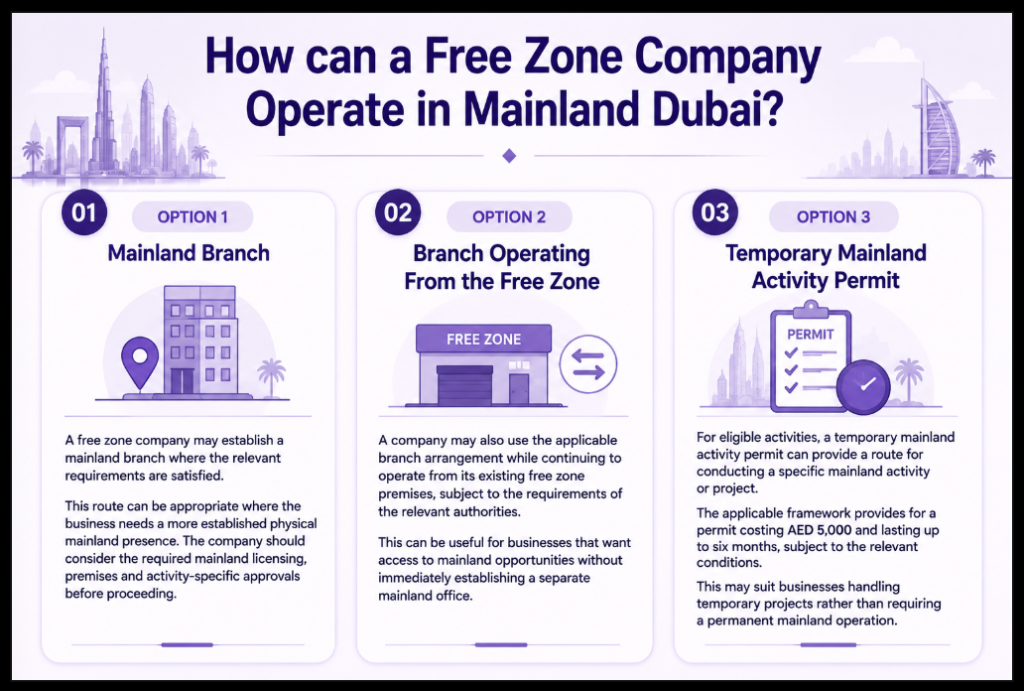
Businesses considering Dubai business setup or mainland expansion should assess the applicable route based on their activity, premises and operating requirements.
What about a Mainland Distributor or Agent?
A mainland distributor or agent can be an alternative route, particularly for businesses selling physical goods.
This structure should not be confused with the specific routes introduced under Dubai Resolution No. 11. A distributor may handle domestic sales and distribution while the free zone company remains established in its existing jurisdiction.
The appropriate arrangement depends on the product, activity, contractual structure and regulatory requirements.
What is a Dual Licence?
A dual-licence arrangement can allow certain free zone businesses to conduct mainland activities under arrangements offered by specific free zones.
However, dual licensing is not a universal fourth route available to every free zone company. Availability, eligibility and conditions vary by free zone.
For example, certain arrangements are available through free zones such as RAKEZ, subject to its applicable requirements.
Free Zone Company Mainland Options | Comparison
| Route | Cost/Validity | Physical Office | Suitable For |
| Mainland branch | Depends on approvals | May be required | Permanent mainland presence |
| Branch from free zone | Applicable authority fees | Existing free zone premises may be used | Businesses retaining free zone base |
| Temporary activity permit | AED 5,000 / up to 6 months | Activity-dependent | Temporary projects |
| Distributor/agent | Contract-dependent | Distributor handles mainland presence | Goods and trading |
| Dual licence | Free-zone specific | Depends on arrangement | Eligible free zone businesses |
Which Mainland Option is Right for Your Business?
The appropriate route depends on what the business actually needs.
E-commerce and SaaS: Businesses primarily selling digital products or services may be able to serve mainland customers without establishing a full mainland operation, subject to activity-specific requirements.
Consultancy and professional services: Consider whether services are being delivered remotely or whether employees will physically operate from mainland premises.
Trading: Businesses importing and selling physical goods need to consider customs, distribution and domestic-market requirements.
Retail: A physical mainland shop generally requires an appropriate mainland operating arrangement and premises approvals.
Healthcare and education: These sectors can involve additional regulatory approvals, so the applicable activity should be checked before selecting a route.
Businesses that are still deciding between structures can also review the benefits of Dubai free zone company formation before choosing an expansion model.
How much does it cost to operate in Mainland Dubai?
There is no single cost applicable to every free zone company.
Potential expenses include:
- Mainland authorisation or licensing fees
- Branch-related fees
- Temporary permit fees
- Office or premises costs
- Professional approvals
- Employee visas
- Government charges
- Tax and accounting costs
- Activity-specific approvals
For the temporary mainland activity permit, the applicable fee is AED 5,000 for up to six months. Other routes require separate cost assessment.
Can a Free Zone Company Invoice Mainland Customers?
Generally, a free zone company can have mainland customers and issue commercial invoices for legitimate business transactions, subject to the company’s licensed activity and applicable regulatory requirements.
However, invoicing a mainland customer is not the same as physically conducting an unlicensed mainland operation.
Businesses should distinguish between the customer’s location and the location where the business activity is actually performed.
Can a Free Zone Company Sell Goods in Mainland UAE?
It may be possible, but physical goods involve additional considerations.
Businesses may need to consider:
- Customs procedures
- Import requirements
- Distribution arrangements
- Product-specific approvals
- Mainland trading requirements
- Relevant licensing arrangements
A distributor or an authorised mainland route may therefore be appropriate depending on the business model.
Can a Free Zone Company Provide Services to Mainland Clients?
For many service businesses, the distinction between customer location and physical operation is particularly important.
Consultancies, technology companies, marketing agencies and SaaS businesses may have mainland customers while remaining established in a free zone.
However, regulated activities or businesses physically delivering services from mainland premises may require additional permissions.
Can a Free Zone Company Operate From Its Existing Free Zone Office?
Yes, where the applicable mainland route specifically permits the business to maintain its existing free zone premises.
The branch-from-free-zone model is particularly relevant for businesses that want to access mainland opportunities without immediately taking a separate mainland office.
The company should confirm the applicable conditions with the relevant authorities before beginning mainland operations.
What Business Activities Can Operate in Mainland Dubai?
Eligibility is activity-specific.
Businesses should verify their proposed activity against the applicable Dubai requirements and approved activity framework rather than assuming that every free zone activity qualifies.
This is particularly important for regulated sectors, professional activities, trading and activities requiring additional government approvals. Businesses that need to add a mainland business activity should assess whether the proposed activity is permitted and what additional approvals may apply.
What Approvals are Required?
Depending on the selected route and activity, businesses may need:
- Free zone company documents
- Existing trade licence
- Mainland branch or permit documentation
- Activity details
- Premises documents where applicable
- NOCs where required
- Government or sector-specific approvals
- Relevant corporate documents
The exact requirements depend on the chosen route and business activity.
Documents Required to Expand From Free Zone to Mainland
Common documents may include:
- Free zone trade licence
- Certificate of incorporation
- Memorandum and Articles of Association
- Shareholder documents
- Manager/director documents
- Activity details
- NOC where applicable
- Lease or premises documentation
- Relevant approval documents
The authority may request additional documents depending on the structure and activity. Businesses considering a new mainland entity can also review the requirements for UAE company setup before deciding whether a separate mainland structure is appropriate.
Does Mainland Operation Affect Free Zone Corporate Tax?
Potentially, yes.
Free zone companies need to assess their UAE Corporate Tax position carefully when generating mainland income or establishing a mainland presence. A Qualifying Free Zone Person’s treatment depends on the applicable Corporate Tax rules, qualifying activities and income, and whether the business creates circumstances affecting its qualifying status.
Businesses should also consider the wider UAE taxation system when assessing the financial impact of mainland expansion.
Mainland expansion should therefore be assessed from both a licensing and tax perspective.
What Free Zone Companies Still Cannot Do
A free zone company should not assume that its existing licence permits it to:
- Open an unrestricted mainland shop
- Establish unapproved mainland premises
- Conduct regulated activities without approval
- Employ staff for unauthorised mainland operations
- Ignore activity-specific requirements
- Treat every emirate as operating under Dubai’s rules
The free zone licence remains subject to its own terms even when a business obtains an additional mainland route.
Can a Free Zone Company Operate in Abu Dhabi, Sharjah or RAK?
Not automatically under Dubai Resolution No. 11.
A company wanting to operate in Abu Dhabi, Sharjah or Ras Al Khaimah should assess the rules of the relevant emirate.
For businesses considering Abu Dhabi free zone company formation, the applicable Abu Dhabi framework should be reviewed separately rather than relying on Dubai’s rules.
For example, RAKEZ free zone provides its own mechanisms for eligible free zone companies seeking mainland access. This illustrates why businesses should check the relevant jurisdiction rather than applying one UAE-wide assumption.
Free Zone to Mainland Expansion | Step-by-Step Process
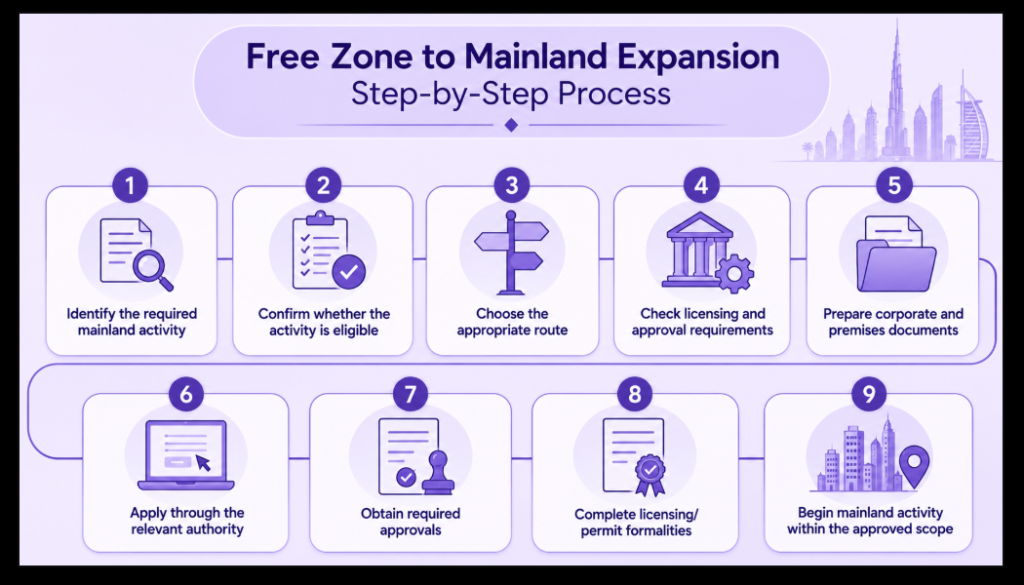
The exact sequence can differ depending on the route, emirate and activity.
What are the Common Mistakes When Expanding From Free Zone to Mainland?
Businesses commonly make the following mistakes:
- Assuming the free zone licence is sufficient
- Confusing mainland customers with mainland operations
- Ignoring activity eligibility
- Treating Dubai’s rules as UAE-wide rules
- Assuming a distributor is always required
- Overlooking premises requirements
- Ignoring tax implications
- Starting regulated activities before obtaining approvals
Proper planning can prevent unnecessary licensing costs and compliance problems.
What are the Benefits of Expanding From Free Zone to Mainland?
A compliant mainland expansion can help a business:
- Access additional customers
- Establish a physical mainland presence
- Bid for suitable contracts
- Expand its workforce
- Scale operations
- Retain its existing free zone structure where permitted
Understanding the advantages of UAE free zones can also help businesses assess whether retaining their existing free zone structure alongside mainland access makes commercial sense.
Businesses evaluating specific free zone locations may also consider options such as Meydan Free Zone or DMCC free zone depending on their activity and expansion plans.
The objective should be to select the least complicated structure that genuinely supports the company’s commercial needs.
FAQs
Can a UAE free zone company sell to mainland customers without opening a mainland company?
Yes, depending on the activity and operating model, a free zone company can serve mainland customers without forming a separate mainland company.
Can a free zone company invoice customers in mainland UAE?
Yes, mainland customers can generally be invoiced, subject to the company’s licensed activity and applicable regulatory requirements.
Can a free zone company trade directly in the UAE domestic market?
It depends on the goods, activity, distribution structure and applicable mainland licensing or approval requirements.
Which UAE free zones allow companies to access the domestic mainland market?
Access depends on the free zone and jurisdiction; businesses must check the specific mainland-access mechanism available.
Can a free zone company operate anywhere in the UAE mainland?
No. A free zone licence does not automatically authorise unrestricted physical operations across UAE mainland jurisdictions.
Can a free zone company have mainland customers while keeping its office in the free zone?
Yes, subject to the activity and applicable rules governing how the services or sales are conducted.
Can a free zone company open a mainland branch while keeping its free zone licence?
Yes, eligible companies may establish a mainland branch while retaining their existing free zone structure.
Does a free zone company need a mainland distributor to sell products?
Not necessarily; the appropriate route depends on the product, activity, distribution structure and applicable regulations.
Which structure is best for domestic UAE sales?
The best structure depends on the activity, physical presence, customers, costs, licensing requirements and expansion plans.
How can Arnifi Help With Mainland Expansion?
Arnifi can help businesses evaluate UAE company structures, licensing requirements and expansion options when a free zone company wants to access mainland opportunities.
Support can include:
- Company formation
- Mainland and free zone setup
- Licensing guidance
- Corporate structuring
- Compliance support
- Expansion planning
The right structure should be selected based on the company’s actual activity and operating model rather than simply choosing the cheapest licence.
Conclusion
A free zone company can access mainland UAE opportunities, but its existing free zone licence does not automatically provide unrestricted mainland operating rights.
For Dubai businesses, Resolution No. 11 of 2025 creates specific routes for eligible companies, including mainland branches, branch arrangements operating from free zone premises and temporary mainland activity permits. Distributor arrangements and free-zone-specific dual licences can provide additional options in appropriate circumstances.
The key is to distinguish serving mainland customers from physically operating in mainland UAE and to verify the applicable rules for the activity and emirate before starting operations. To know more, reach out to our experts at Arnifi today!
Reference links
Top UAE Packages


Related Articles

Top UAE Packages
Get in Touch